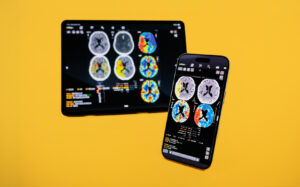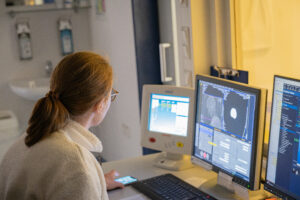

At ASL Viterbo, an integrated workflow combines automated perfusion analysis with mobile clinical decision support.
In early August, it finally happened: mRay is now being used in daily clinical practice at the ASL Viterbo hospital network, together with the perfusion analyses from Cercare Medical . This marks the first joint installation since the partnership was established and the first concrete use case demonstrating what the two companies aim to achieve together: closing the gap between medical imaging, automated analysis, and clinical decision-making.
The Starting Point: Time Pressure and Fragmented Workflows
In acute care, every minute counts. In cases of stroke, intracranial hemorrhage, or traumatic brain injury, treatment teams must make informed decisions under significant time pressure — based on complex imaging that typically requires specialist assessment. Yet this level of expertise isn't always available around the clock, especially at smaller or more remote centers.
High-quality imaging is available in most hospitals. The real challenge lies in getting that information — without delay — from image acquisition to the clinicians making treatment decisions. Findings, images, and consultations are often scattered across different systems, phone calls, and locations.
That's exactly where Cercare Medical and mRay come together: Cercare delivers automated, quantitative analysis of the imaging data, while mRay makes these insights directly available to the treatment teams — precisely when and where they're needed.
Cercare Medical's Contribution
Cercare Medical automatically analyzes CT, CBCT, and MRI brain perfusion data, delivering results directly into the PACS. This is powered by the company's proprietary Vascular Model, which enables precise delineation of hypoperfused areas.
In addition to established perfusion parameters, the software provides automated ASPECTS scores, AI-based segmentation of infarct core and penumbra along with advanced metabolic markers and other clinically relevant outputs. The product range spans from Cercare CT/MR Stroke to the Advanced variant, up to Cercare MR Neuro Advanced — covering both stroke and neuro-oncological use cases.
In short: Cercare answers the quantitative question — how large is the infarct core, how much potentially salvageable tissue remains, and what is the condition of the affected tissue? The result is a standardized and traceable foundation for further clinical assessment.
What mRay Brings to the Table
An analysis is only useful if it reaches the right people quickly. This is where mRay comes in — not as another analysis tool, but as a communication and decision-making layer built around medical imaging. Mobile access is especially critical here and is one of mRay's core strengths: the platform was built from the ground up to provide secure access to medical imaging data on mobile devices.
At ASL Viterbo, the clinical workflow is structured as follows:
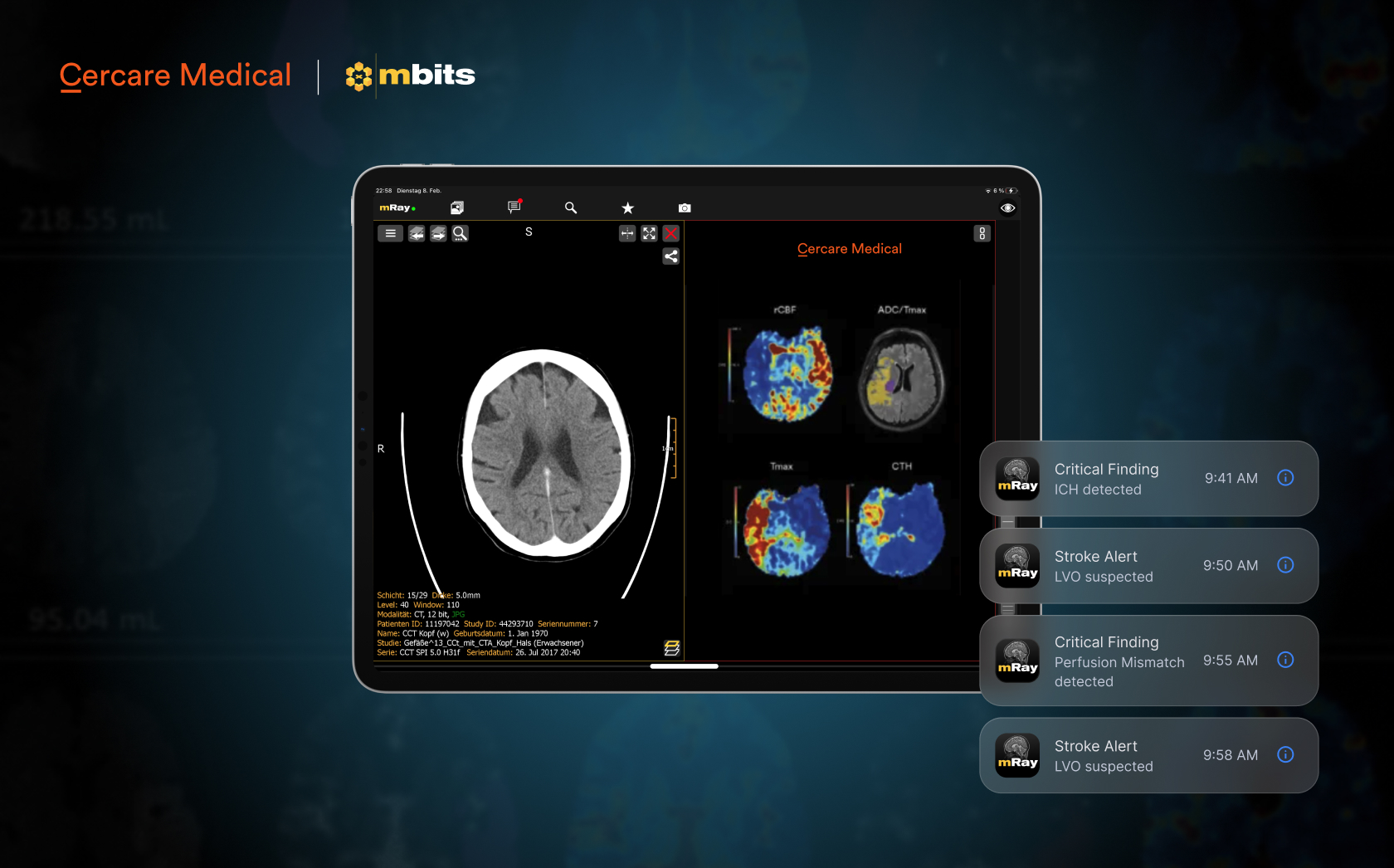
- Once Cercare has calculated the perfusion maps and made them available in the PACS, mRay automatically identifies relevant cases through rule-based workflows — for example, in cases of suspected large vessel occlusion (LVO) or intracranial hemorrhage (ICH).
- The responsible on-call physicians in neurology, neuroradiology, and, if needed, interventional neuroradiology, are automatically notified on their smartphone, tablet, or desktop. Critical cases can be escalated directly to the right specialist.
- A preconfigured image view makes the native CT and corresponding perfusion maps immediately available. This means the case is fully prepared for clinical assessment from the outset, without having to manually gather images or relay findings by phone.
- The subsequent case discussion takes place via secure, case-based chat, along with real-time image sharing and screen sharing. This allows the specialists involved in the case to coordinate regardless of whether they are at the same site or at different hospitals.
Technically, mRay is designed as a mobile imaging platform built to integrate into existing clinical IT infrastructure. As a Class IIb medical device, mRay can be used independently of the PACS, operating system, and browser.
As a result, analysis findings aren't just delivered — they're directly embedded into interdisciplinary decision-making.
The outcome is a seamless workflow: from CT or MR acquisition, through automated perfusion analysis, to shared clinical decision-making — without the breaks between systems and communication channels that can cost valuable time in complex stroke networks.
Into Clinical Practice: The Viterbo Rollout with KASTER Medical Technology
The implementation in Viterbo was carried out together with KASTER Srl, Cercare Medical's exclusive distributor in Italy. Based in Rome, the company specializes in supplying hospitals, clinics, and universities with medical and surgical technologies, offering specialized software solutions alongside medical technology products.
For the rollout at ASL Viterbo, KASTER handled the on-site installation and setup, while the mbits imaging team supported the remote configuration of mRay.
The systems were aligned so that the perfusion analyses generated by Cercare can be automatically integrated into mRay workflows: relevant examinations are identified, the appropriate teams are notified, and the imaging data needed for assessment is made immediately available.
A Shared Workflow for Stroke Care
With the installation at ASL Viterbo, the partnership between Cercare Medical and mbits imaging is now being put into practice in a real-world clinical setting for the first time. A heartfelt thank you goes to everyone involved at Cercare Medical, KASTER Srl, and ASL Viterbo for the great collaboration and for making this first joint project a success.